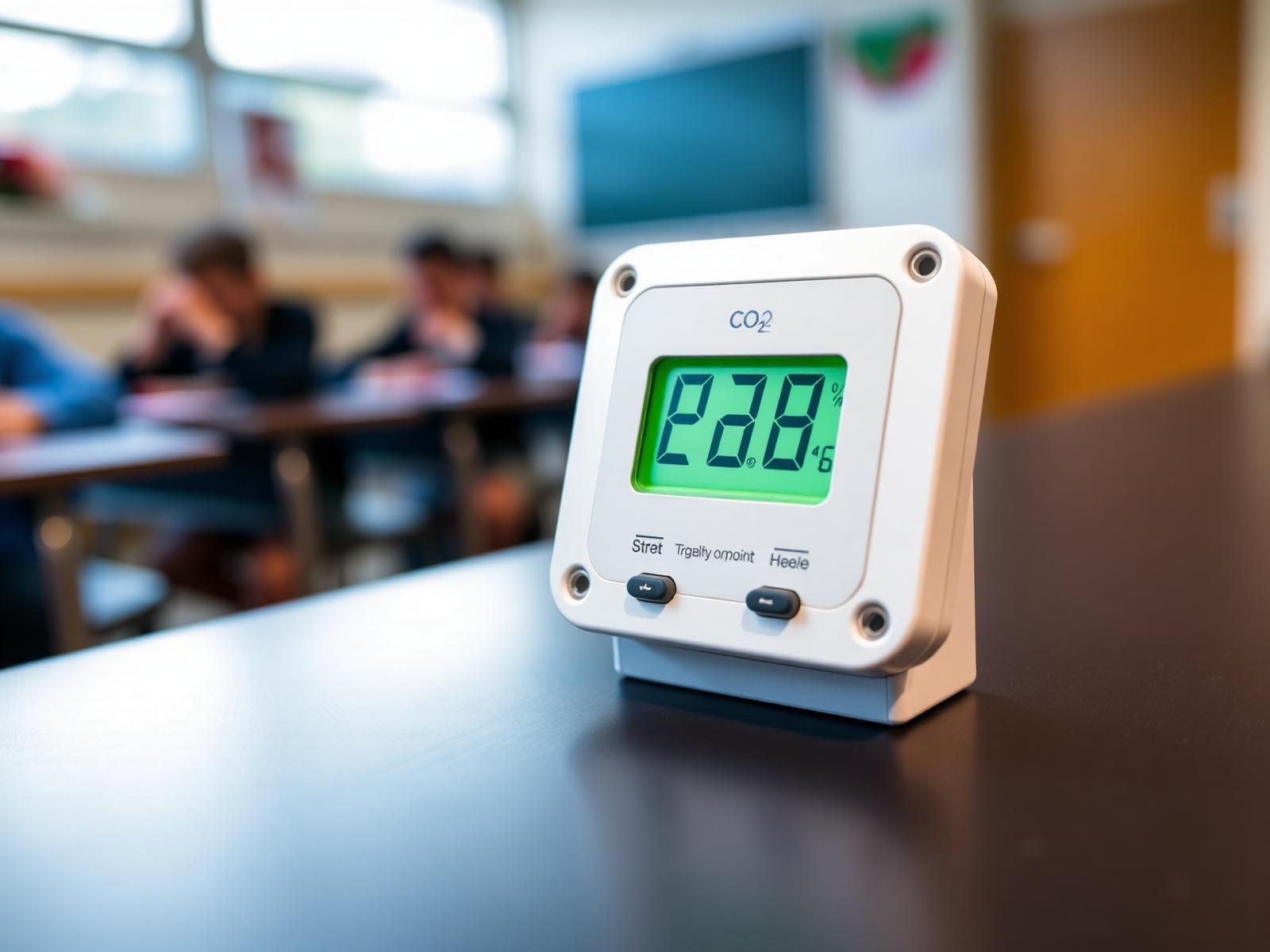
Why air quality testing matters in schools
Children spend roughly a third of their waking time inside school buildings, often in rooms designed and built decades before today's class sizes and curriculum. Many UK schools combine high occupant density, restricted opening windows for safety, and ageing or retro-fitted ventilation. The result is air that can carry significantly more CO₂, particulates and chemical pollutants than the surrounding outdoor environment.
Sustained exposure to poor indoor air affects concentration, attendance and the comfort of staff as well as pupils. Independent testing turns that abstract concern into measured, room-specific data — the starting point for any credible improvement programme, refurbishment business case or response to parental queries.
Common causes of poor air quality in school buildings
Most school air-quality problems are not caused by a single failure — they are the result of several normal building behaviours stacking up across a teaching day.
- High occupancy in small rooms with limited fresh-air supply
- Trickle vents painted shut or windows sealed for safeguarding or noise
- Mechanical ventilation systems that are undersized, unbalanced or running on legacy controls
- Cleaning chemicals, paints, adhesives, new furniture and craft materials releasing VOCs and formaldehyde
- Mould or persistent damp in older flat roofs, basements and Victorian fabric
- Traffic, school-run idling and nearby industry contributing NO₂ and particulates through air intakes
Our school air quality testing approach
We start with a short scoping conversation to understand the buildings, the rooms causing concern and any earlier surveys or complaints. From that we agree the right combination of spot testing, short-term sampling and, where appropriate, longer-term sensor deployment.
Testing is carried out by trained technicians using calibrated reference-grade and research-grade instruments. We follow a documented method per pollutant, time visits around timetables, and capture occupancy and ventilation conditions alongside the readings so the data is properly contextualised.
What we typically measure
- • Carbon dioxide (CO₂) — ventilation indicator
- • PM2.5 and PM10 — fine and coarse particulates
- • Total volatile organic compounds (TVOC)
- • Formaldehyde (HCHO)
- • Nitrogen dioxide (NO₂) where outdoor air is a factor
- • Temperature and relative humidity
- • Optional: mould spores, radon, ozone, CO
Practical outputs you receive
- • Classroom-level results table with benchmarks
- • Short executive summary for senior leadership
- • Ranked recommendations: quick wins to capital works
- • Annotated floor plans where useful
- • Optional follow-up monitoring plan
- • Supporting evidence for refurbishment business cases
Suitable schools and settings
- Primary and secondary schools
- Nurseries and early-years settings
- Sixth forms and FE colleges
- Multi-academy trusts coordinating estates strategy
- Local authority school portfolios
- Independent and SEND schools
- New build and major refurbishment projects
- Schools responding to staff or parent concerns
Frequently asked questions
What does school air quality testing actually measure?+
A typical test programme covers carbon dioxide as a ventilation indicator, fine particulate matter (PM2.5 and PM10), total volatile organic compounds (TVOC), formaldehyde, nitrogen dioxide where outdoor air is a factor, and temperature and relative humidity. Specific pollutants such as mould spores or radon can be added where the building history suggests it.
Do you test individual classrooms or just the building as a whole?+
We test at room level. Whole-building averages tend to hide the rooms that matter most — north-facing classrooms with closed windows in winter, science labs, drama studios and small group rooms. Reports are produced classroom-by-classroom so estates teams and heads can act on specific spaces.
How long does a school air quality test take?+
Spot testing of a single classroom takes 30–60 minutes per pollutant suite. A short-term study across a wing or year group typically runs over one to five teaching days. Longer continuous studies use deployed sensors and can run for weeks or terms — see school environmental monitoring.
Will testing disrupt lessons?+
No. Instruments are compact and silent, and our technicians work to a pre-agreed plan with the school office. Sampling can be timed around break, lunch, examinations and SEND timetables.
What happens after the testing visit?+
You receive a written report with classroom-level results, contextual benchmarks (CIBSE TM40, WHO 2021, BB101 where applicable for the UK), a plain-English explanation, and practical recommendations. Where useful, we suggest follow-up monitoring or a ventilation assessment.
Ready to take a closer look at your school's air?
Tell us about your buildings and the rooms or year groups you're concerned about. A specialist will be in touch within one working day.