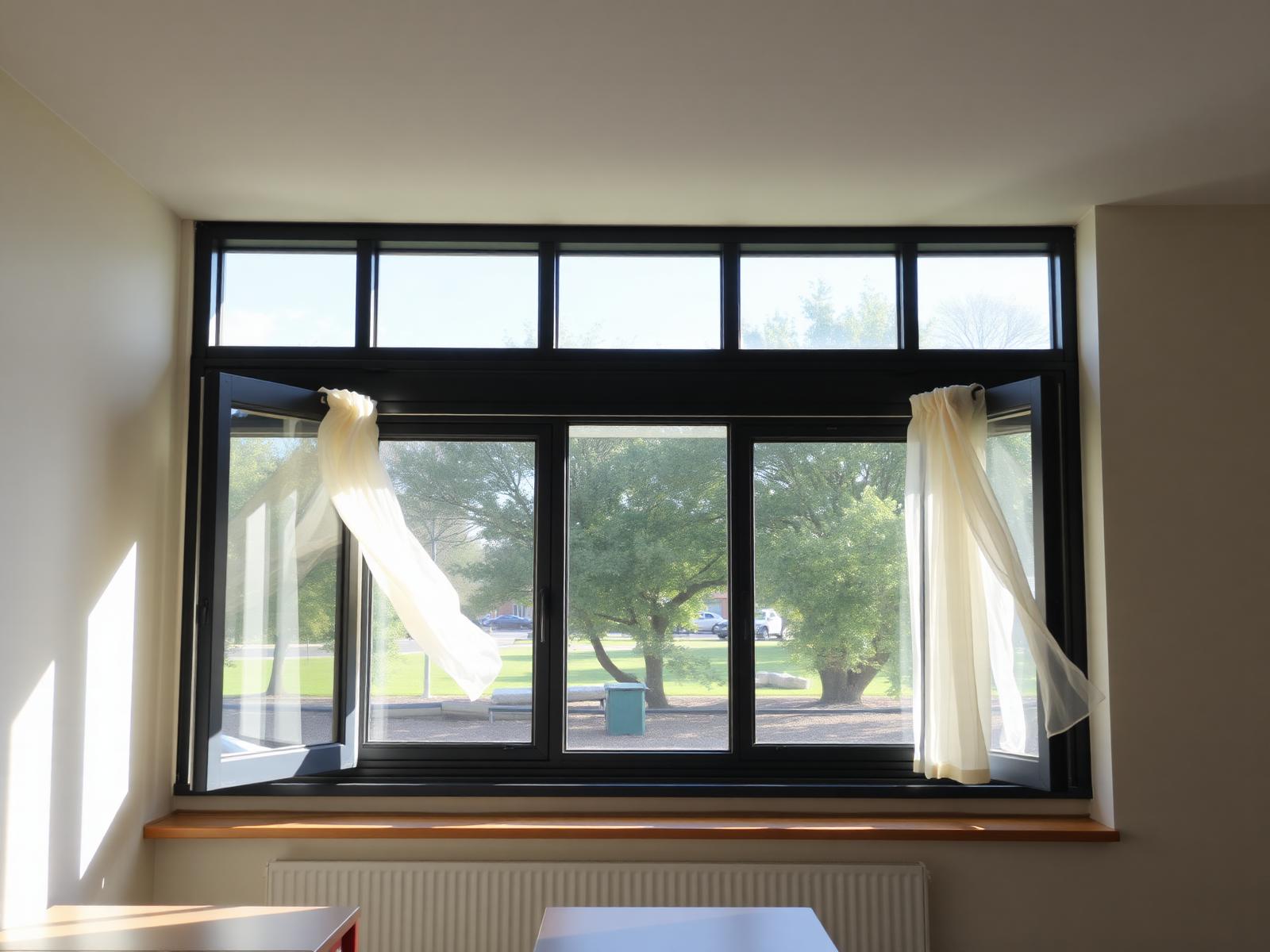
Why ventilation performance matters in schools
Ventilation is the single biggest lever a school has over its indoor environment. Most classroom comfort complaints, most stuffy lessons after break, most CO₂ readings above 1,500 ppm and a large share of mould and condensation issues are ventilation problems first and pollutant problems second.
School ventilation is also harder than it looks. Class sizes vary, windows are sometimes restricted for safety, mechanical systems can be undersized or unbalanced, controls may have drifted away from intent, and timetables stack high-occupancy use back-to-back. Assessing the real performance — not the design intent — is essential.
Common ventilation problems in school buildings
Most issues fall into a small number of recognisable patterns. Identifying which pattern applies to your building shapes everything else.
- Natural ventilation rooms with windows that occupants don't or can't open
- Mechanical systems running to the wrong schedule or modulating below useful flow
- Supply or extract grilles blocked, dirty or never commissioned
- Heat recovery units bypassed or unbalanced
- Trickle vents painted shut during redecoration
- Cross-ventilation defeated by partitioning, displays or layout changes
- Rooms originally designed for smaller class sizes than today's roll
How we assess school ventilation
We combine a structured walk-through with measurement. For mechanical systems we measure terminal airflows, check balance against design intent, and verify control behaviour during occupied hours. For naturally ventilated rooms we assess opening areas, stack and wind drivers and CO₂ behaviour under realistic occupancy.
Where useful, we deploy short-term CO₂, temperature and humidity sensors across the rooms in scope so the assessment includes real teaching-day data, not just spot readings. Findings are benchmarked against BB101, CIBSE TM40 and BS EN 16798 as appropriate to the building.
What we measure and review
- • Supply and extract airflows at terminals
- • CO₂ behaviour under occupied conditions
- • Temperature and relative humidity in occupied rooms
- • Room volumes, opening areas and occupancy
- • Control settings, schedules and BMS behaviour
- • Filter condition, heat recovery operation
Recommendations and outputs
- • Room-by-room ventilation performance ranking
- • Operational fixes and commissioning corrections
- • Capital recommendations with indicative scope
- • BB101 / TM40 / EN 16798 benchmarking
- • Brief for follow-up monitoring or design
- • Evidence pack for CIF and capital bids
Suitable schools and settings
- Naturally ventilated traditional school buildings
- MVHR or mixed-mode classrooms
- School halls, dining and large-volume spaces
- Science labs and design and technology workshops
- Sports halls, drama studios and music rooms
- Refurbished and new-build schools
- Modular and temporary classrooms
- Multi-academy trust portfolios standardising approach
Frequently asked questions
What does a school ventilation assessment include?+
A walk-through of the rooms in scope, review of the building's ventilation strategy (natural, mechanical or mixed), measurement of airflow and CO₂ against occupancy, and an assessment of how well fresh air actually reaches occupants. The output is a written report with room-level findings and prioritised recommendations.
Do you test airflow as well as CO₂?+
Yes. Where mechanical ventilation is present we measure supply and extract airflows at terminals and balance them against design intent. For natural ventilation we assess opening areas, wind/stack drivers and CO₂ behaviour under realistic occupancy. CO₂ is treated as an indicator, not the only metric.
Will the assessment tell us if our ventilation meets BB101?+
We benchmark findings against Building Bulletin 101 ventilation criteria where applicable, alongside CIBSE TM40 and BS EN 16798. We are explicit about which criteria apply to your building (new, refurbished, existing) and where pragmatic targets are appropriate.
Can ventilation assessments inform refurbishment design?+
Yes. Findings are routinely used as evidence in CIF bids, condition surveys, decarbonisation programmes and design briefs for mechanical, electrical and HVAC consultants — making sure ventilation upgrades are designed around how the rooms are actually used.
Is monitoring a substitute for assessment?+
No — they answer different questions. Monitoring tells you what is happening; assessment explains why and what to do about it. Most schools benefit from an assessment first, then continuous monitoring to track progress.
Ready to take a closer look at your school's air?
Tell us about your buildings and the rooms or year groups you're concerned about. A specialist will be in touch within one working day.