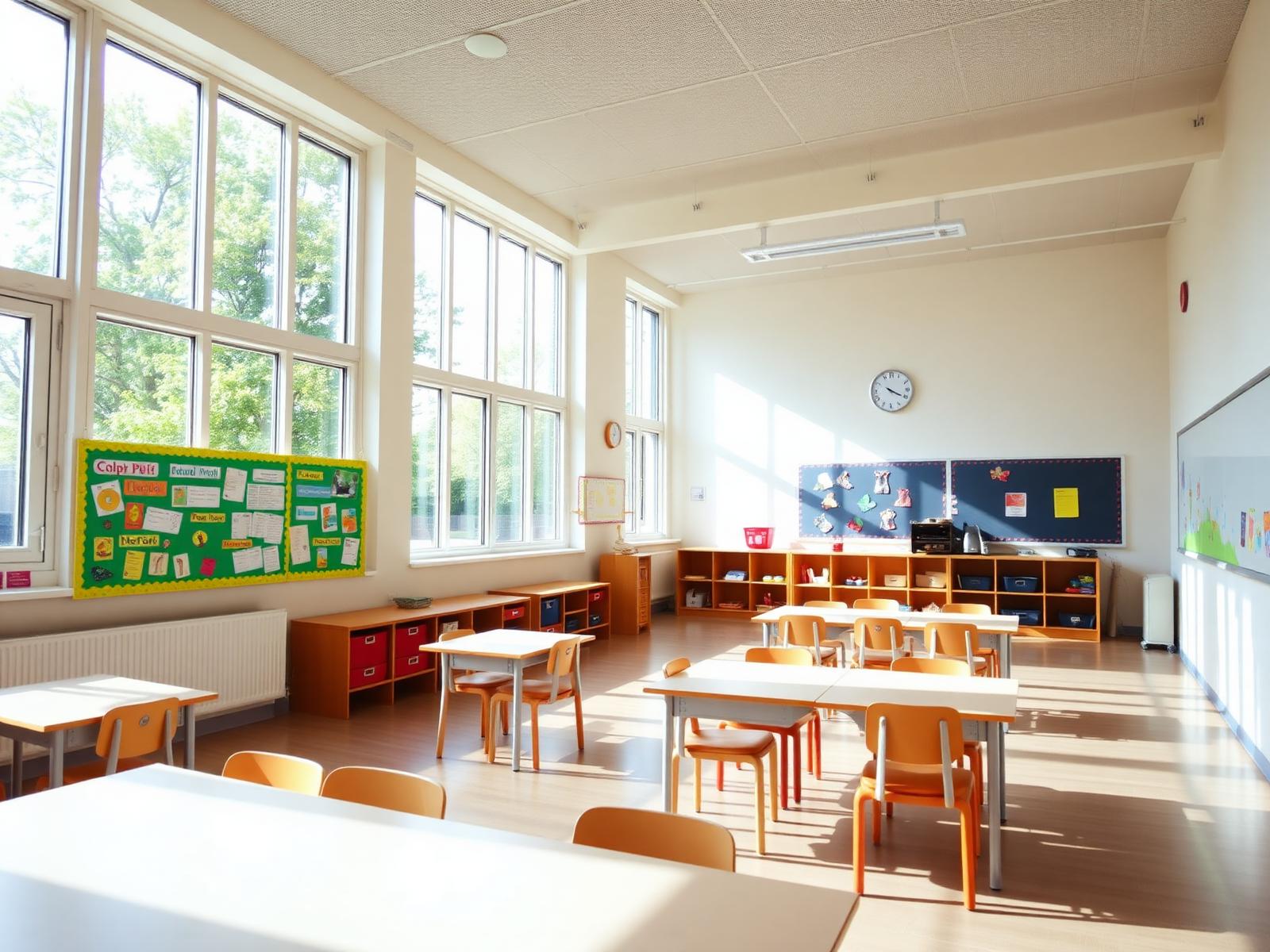
What we mean by a healthy school environment
The indoor environment is the setting in which the school day actually happens. Pupils in the UK typically spend around 30 hours a week inside school buildings; staff spend considerably more. When the rooms are comfortable, well-ventilated and clean, that environment fades into the background. When it is not, it shows up as drowsiness, stuffiness, headaches, complaints and lost teaching time.
A healthy-schools approach asks the same questions of every space pupils and staff use — not just classrooms — and treats the indoor environment as something to plan, monitor and improve over time, in the same way an estate plans for safeguarding, fire safety or maintenance.
The factors that shape a healthy school
Six environmental factors do most of the work. They are interlinked: changes to ventilation affect temperature; changes to occupancy affect carbon dioxide; changes to cleaning regimes affect chemical exposure. A healthy-schools view looks at them together rather than separately.
- Ventilation — natural, mechanical or mixed-mode systems that deliver fresh air to occupied rooms
- Air quality — carbon dioxide, fine particulates, volatile organic compounds and formaldehyde
- Thermal comfort — temperature, overheating risk and the effect of solar gain in summer
- Humidity and moisture — condensation risk, damp areas and the conditions for mould growth
- Cleanliness and materials — cleaning chemistry, furniture, carpets and craft materials
- Operation and maintenance — whether systems run when rooms are in use and stay maintained
Why a whole-school view matters
Classrooms get the most attention, and rightly so, but they are only part of the school estate. Halls and assembly spaces concentrate high numbers of people for short bursts; libraries and sixth-form study areas have long, low-level occupancy; dining halls add cooking and food-prep emissions; sports and changing facilities have very different moisture loads; offices, staff rooms and meeting rooms are easy to overlook.
Looking across all of these together avoids fixing one room while another quietly worsens. It also gives estates and finance leaders the basis to prioritise — a healthy-schools picture lets you compare rooms and buildings on the same terms, instead of reacting to whichever complaint is loudest.
Monitoring and review
Most schools benefit from a layered approach. A baseline assessment establishes how the current estate is performing. Periodic testing adds detail where it is needed. Continuous monitoring — most commonly CO₂ in occupied teaching spaces — confirms whether changes are holding up day to day and supports the case for capital work where it is justified. A short annual review keeps the picture current as occupancy, timetables and the estate change.
Monitoring is most useful when it feeds into decisions: which rooms to timetable differently, where to prioritise window or vent maintenance, which mechanical ventilation needs balancing, and which capital projects deserve to move up the plan.
Estate-wide improvement planning
Improving the school environment is rarely a single project. It is a sequence of small operational changes (how rooms are used, how systems are run, how cleaning is specified) alongside larger capital changes (ventilation upgrades, window and trickle-vent refurbishment, mechanical plant replacement). A healthy-schools plan sequences those changes against budget cycles and disruption windows.
For multi-academy trusts and local authorities, the same framework lets each site be assessed on the same basis and compared. That makes it possible to share lessons across the estate and pool procurement where it makes sense.
Support for schools, MATs and local authorities
We work with single schools, multi-academy trusts and local authority estates teams to make this practical: scoping the estate, focusing on the rooms and buildings that matter most, and producing reports and monitoring data that decision-makers and governors can actually use. Use the links to the right to go deeper on a specific topic, or get in touch to discuss your estate.
Frequently asked questions
What is a healthy school?+
In environmental terms, a healthy school is one whose buildings are managed so the indoor air, ventilation, temperature, humidity, lighting and cleanliness consistently support concentration, comfort and attendance — across classrooms, halls, libraries, dining spaces, offices and circulation areas, not only the most visible rooms.
How is 'healthy schools' different from 'school indoor air quality'?+
Indoor air quality is one component. A healthy-schools view is wider: it covers air, ventilation, thermal comfort, moisture, cleanliness, occupancy patterns and how the estate is operated and maintained over time. It is the strategic frame the headteacher, business manager, MAT estates lead and governors work in; indoor air quality is one of the technical lenses inside it.
Who is responsible for the indoor environment in a UK school?+
Responsibility is shared. The headteacher and senior leadership are accountable for day-to-day conditions; the school business manager and site team operate the buildings; MAT estates teams and local authority property teams own longer-term planning, refurbishment and capital projects; and governors provide oversight. Specialist advisers support each of these roles.
Where should a school start with environmental improvement?+
Most schools start with a structured assessment of the indoor environment — focused on the rooms or buildings of most concern — and add targeted monitoring where helpful. From there, a short list of operational changes (timetabling, ventilation use, cleaning regimes) usually sits alongside a longer list of capital priorities that fold into the estate plan.
Is this only relevant for new or refurbished schools?+
No. New and refurbished schools have specific guidance (notably Building Bulletin 101 for ventilation), but the day-to-day indoor environment matters in every UK school regardless of building age. Older estates often have more to gain from a structured approach because conditions vary more between rooms.
Ready to take a closer look at your school's air?
Tell us about your buildings and the rooms or year groups you're concerned about. A specialist will be in touch within one working day.