Common sensor types in school settings
Most school monitoring programmes use a small set of sensors chosen for their relevance and reliability. CO₂ is the most useful single parameter for ventilation management. Temperature and humidity provide essential comfort information. Particulate matter sensors (PM2.5, PM10) add visibility on dust and fine particles. VOC indicators give a useful screening signal after refurbishment or fit-out.
Beyond this core set, additional parameters can be added where the brief justifies them, but adding sensors without a clear question usually generates noise rather than insight.
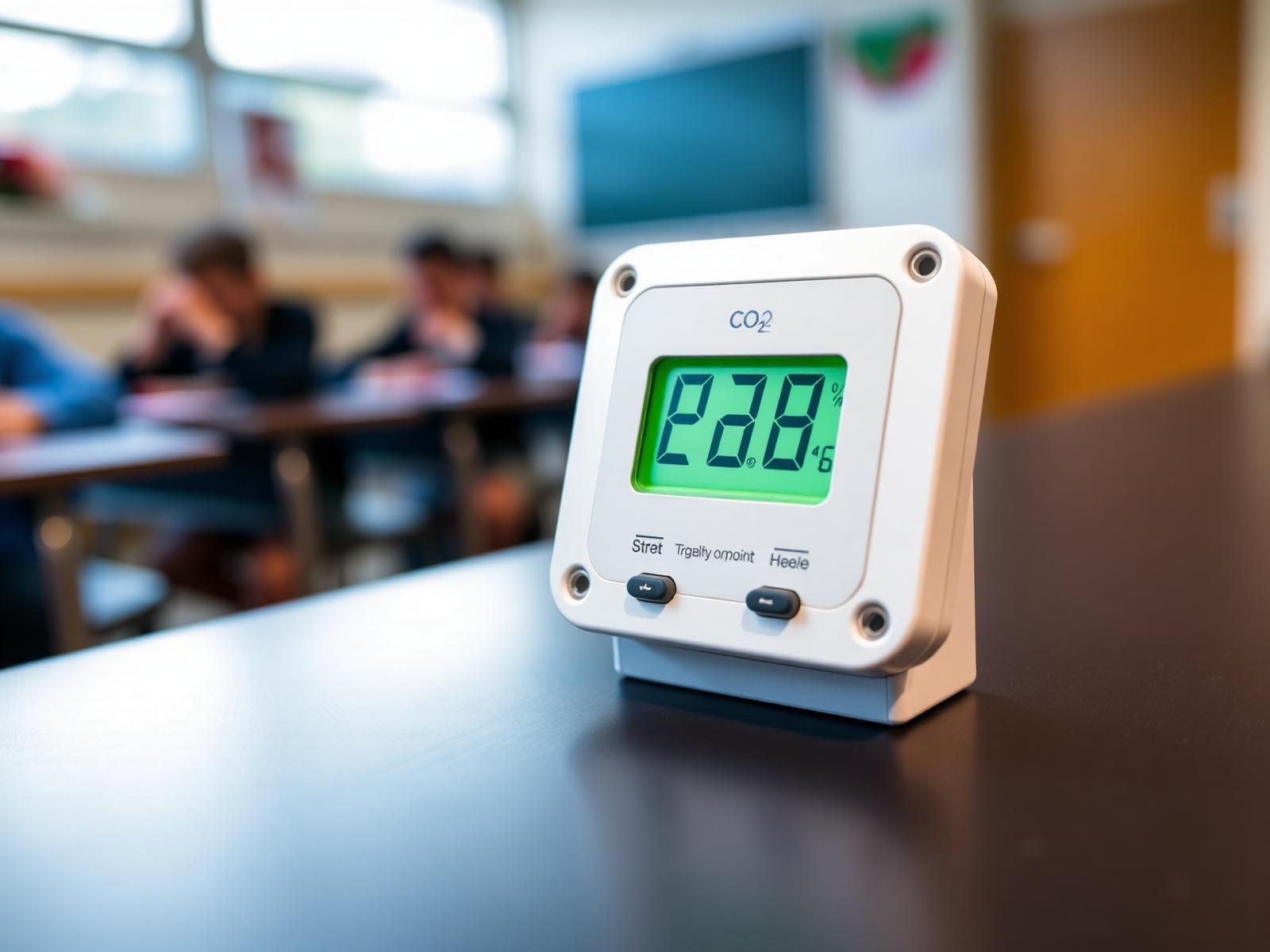
CO₂ sensors
CO₂ is the workhorse of school monitoring. It rises rapidly in occupied rooms with limited ventilation and falls equally rapidly when ventilation improves, which makes it an excellent indicator of how well a room is being ventilated relative to its occupancy. Modern NDIR (non-dispersive infrared) sensors are accurate, stable and well-suited to school use.
Temperature and humidity
Temperature and humidity sensors are inexpensive, accurate and provide essential comfort information. Pairing them with CO₂ gives a strong picture of whether a room is overheating, under-ventilated, or both — and whether ventilation routines are creating uncomfortable conditions in colder months.
Particulate matter sensors (PM2.5, PM10)
Optical particle sensors give useful trend information on PM2.5 and PM10 in classrooms and shared spaces. They are best treated as screening and trend instruments rather than reference-grade analysers. For formal PM testing, see our PM2.5 and PM10 monitoring pages, where calibrated reference methods are used.
VOC indicators
Metal-oxide VOC indicators report a broad, non-specific signal that responds to many compounds. They are useful for screening — particularly after refurbishment or new furniture — and for identifying rooms or time periods that warrant further investigation. They do not substitute for laboratory VOC testing where a specific compound or concentration is in question.
Placement, drift and cross-sensitivity
Placement matters more than is often acknowledged. Sensors belong in the breathing zone, away from direct draughts, windows, heat sources and direct sunlight. Sensors also drift over time — periodic calibration is part of any responsible deployment. And some sensor types (particularly VOC and certain particle sensors) can respond to compounds beyond their primary target, so output is interpreted in context rather than read literally.
Maintenance and data quality
Reliable data depends on light-touch but consistent maintenance: connectivity checks, calibration reviews and periodic confirmation that sensors are reporting plausibly. Most schools find these tasks straightforward when they sit inside the same review cycle as the data itself.
Screening sensors versus professional testing
Sensors and professional testing answer different questions. Sensors are excellent for ongoing operational management, trend analysis and screening. Professional testing — using reference methods, sampling and laboratory analysis — is what answers formal questions about specific compounds and standards. Mature monitoring programmes use both, and are clear with stakeholders about which is appropriate for which decision.
Suitable schools and settings
- Schools specifying their first classroom monitoring deployment
- MATs reviewing existing sensor estates
- Sites combining sensor monitoring with formal testing programmes
- Estates teams establishing standards for placement and calibration
Frequently asked questions
Which sensors do schools actually need?+
It depends on the question. CO₂, temperature and humidity cover the vast majority of classroom-management questions. PM2.5 and PM10 add useful particulate visibility. VOC indicators are useful for screening after refurbishment. Most schools do not need every parameter — they need the right ones for the brief.
Can a sensor reading prove compliance with a standard?+
Not on its own. Sensors are excellent for trends, operational management and screening, but formal compliance with standards usually requires reference methods carried out by qualified testers. We are explicit about which questions sensors can and cannot answer.
How accurate are typical school sensors?+
Modern professional-grade sensors are accurate enough for the operational questions schools ask of them, particularly for CO₂, temperature and humidity. Particle and VOC sensors are usually optical or metal-oxide indicators rather than reference-grade instruments — useful, but interpreted accordingly.
What is sensor drift and does it matter?+
All sensors drift over time. Periodic calibration (or auto-calibration where supported) keeps readings within expected tolerance. Maintenance is light-touch but not optional — sensors that go unmaintained for years should not be relied on for decisions.
Where should sensors be placed in a classroom?+
In the breathing zone, away from direct draughts, windows, heat sources and direct sunlight. Poor placement is the most common reason for misleading data — and the most avoidable. We help schools place sensors correctly during deployment rather than after.
Ready to take a closer look at your school's air?
Tell us about your buildings and the rooms or year groups you're concerned about. A specialist will be in touch within one working day.