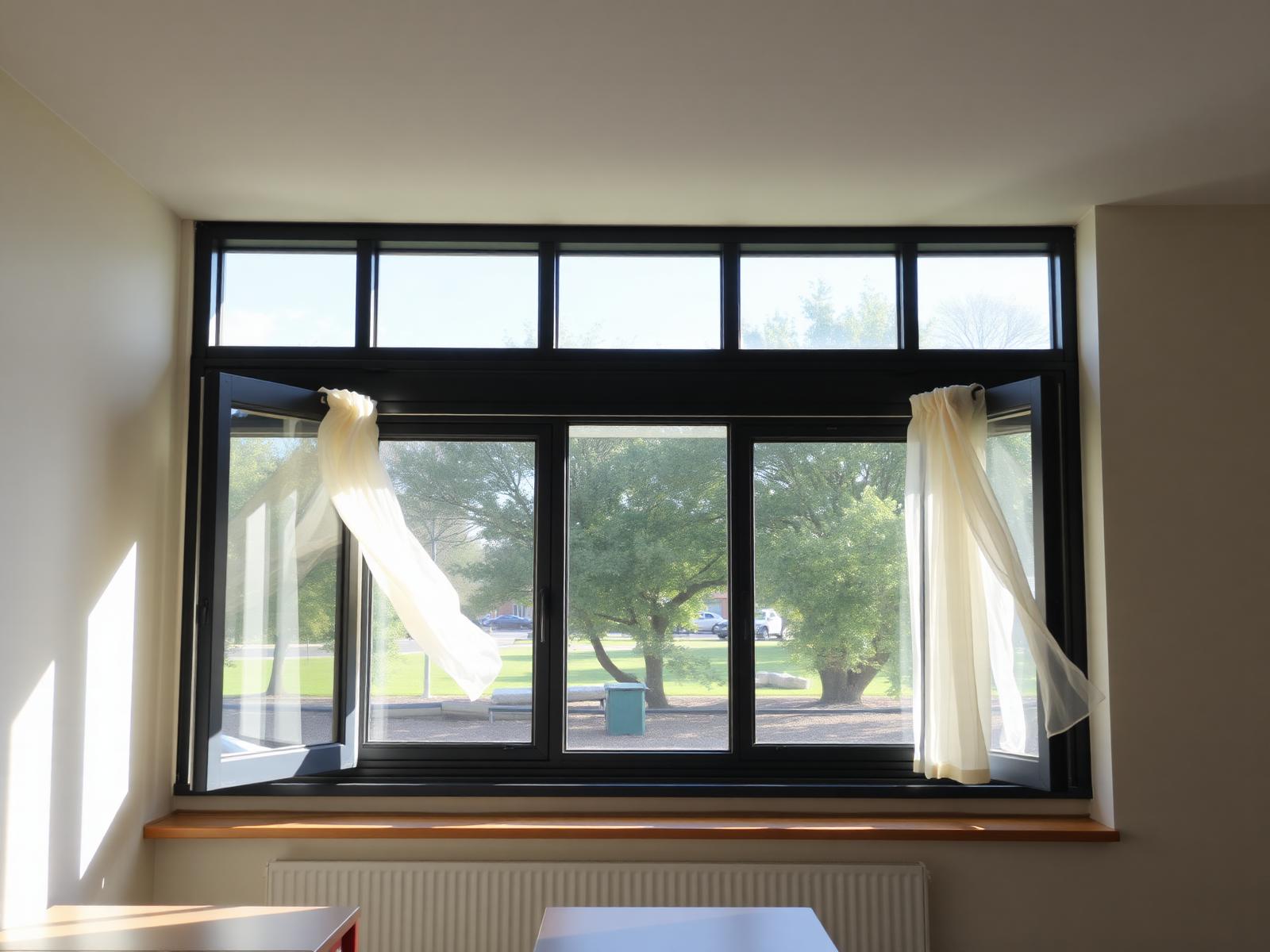
Why classroom ventilation matters
Adequate ventilation supplies the fresh air that occupants need to remain comfortable, alert and well, and removes the carbon dioxide, moisture, particles and chemical pollutants they generate or bring in with them. In a classroom — densely occupied, often for hours at a time — this is harder than in most other spaces.
Ventilation problems tend to show up first as comfort and behaviour issues: stuffiness after break, drowsiness in the afternoon, condensation in winter, persistent complaints about a particular room. The underlying issue is rarely the air itself; it is how much fresh air is reaching the people in the room.
Natural, mechanical and mixed-mode
UK schools use all three strategies, often within the same site. Each has strengths and limitations, and each requires a different kind of assessment.
- Natural ventilation — windows, trickle vents, stack effects; flexible but weather- and behaviour-dependent
- Mechanical ventilation — supply and/or extract systems with controlled flow; reliable but only as good as commissioning and maintenance
- Mixed-mode / hybrid — combines both, often with MVHR for energy efficiency; can be excellent but is sensitive to control strategy
- Demand-controlled — modulates with CO₂ or occupancy; valuable in variable-use rooms
Testing and improving classroom ventilation
For mechanical and mixed-mode rooms we measure terminal airflows, check balance against design intent and verify control behaviour during occupied hours. For naturally ventilated rooms we assess opening areas, CO₂ behaviour and how occupants actually use the windows and vents.
Findings translate into a layered set of recommendations: operational fixes first (controls, schedules, cleaning, opening regimes), targeted commissioning corrections next, and capital recommendations where the building genuinely cannot deliver. Continuous monitoring then verifies that improvements have stuck across seasons.
What we measure
- • Supply and extract airflows at terminals
- • CO₂ behaviour under occupied conditions
- • Temperature and relative humidity
- • Opening areas and window operation
- • Control schedules and BMS behaviour
- • Filter condition and heat-recovery operation
Practical recommendations
- • Operational and behavioural quick wins
- • Recommissioning and rebalancing actions
- • Capital options with indicative scope
- • BB101, TM40 and EN 16798 benchmarking
- • Brief for follow-up monitoring
- • Coordination with refurbishment design teams
Suitable schools and settings
- Naturally ventilated traditional classrooms
- MVHR / mixed-mode teaching rooms
- Modular and temporary classrooms
- Science labs and DT workshops
- Music, drama and SEND spaces
- Refurbishment and new-build projects
- Schools responding to comfort complaints
- MATs standardising estates approach
Frequently asked questions
What does good classroom ventilation actually look like?+
A well-ventilated classroom delivers enough fresh air for its occupancy without significant temperature swings, draughts or noise. CO₂ stays comfortably below 1,000 ppm for most of the day, recovers quickly at break, and does not climb relentlessly through the afternoon. Window opening and mechanical systems are used as intended and respond to how the room is actually used.
Is natural ventilation enough for a UK classroom?+
Sometimes — especially in older buildings with generous opening areas and reasonable cross-ventilation. In winter, in noisy areas, in safeguarding-restricted rooms or in spaces with very high occupancy, natural ventilation alone often cannot deliver the required fresh-air rate. Mixed-mode or mechanical systems are increasingly used as a result.
How do you test classroom airflow?+
For mechanical systems we measure supply and extract airflows at terminals using calibrated instruments. For naturally ventilated rooms we combine opening-area assessment, CO₂ behaviour under realistic occupancy and observation of how the room is actually used. The combination tells us whether the room delivers what it needs.
What are the most common ventilation problems in classrooms?+
Windows that cannot or will not be opened, mechanical units running on default schedules unrelated to occupancy, undersized systems for current class sizes, blocked or dirty grilles, heat-recovery units bypassed, and rooms whose original ventilation strategy was defeated by partitioning, displays or layout changes.
Can ventilation be improved without a major project?+
Often, yes. Recommissioning mechanical systems, adjusting control schedules, removing obstructions from grilles, repairing trickle vents, changing window-opening routines around break and lunch, and timetabling adjustments can all deliver meaningful improvement before any capital spend.
Ready to take a closer look at your school's air?
Tell us about your buildings and the rooms or year groups you're concerned about. A specialist will be in touch within one working day.