Why continuous datasets matter in schools
Indoor air quality in a school is a moving target. Occupancy changes by lesson, ventilation behaviour changes with weather and timetable, and activities such as cleaning, refurbishment and practical work all influence what sensors record. A single hour of data — however accurate — rarely captures that variability.
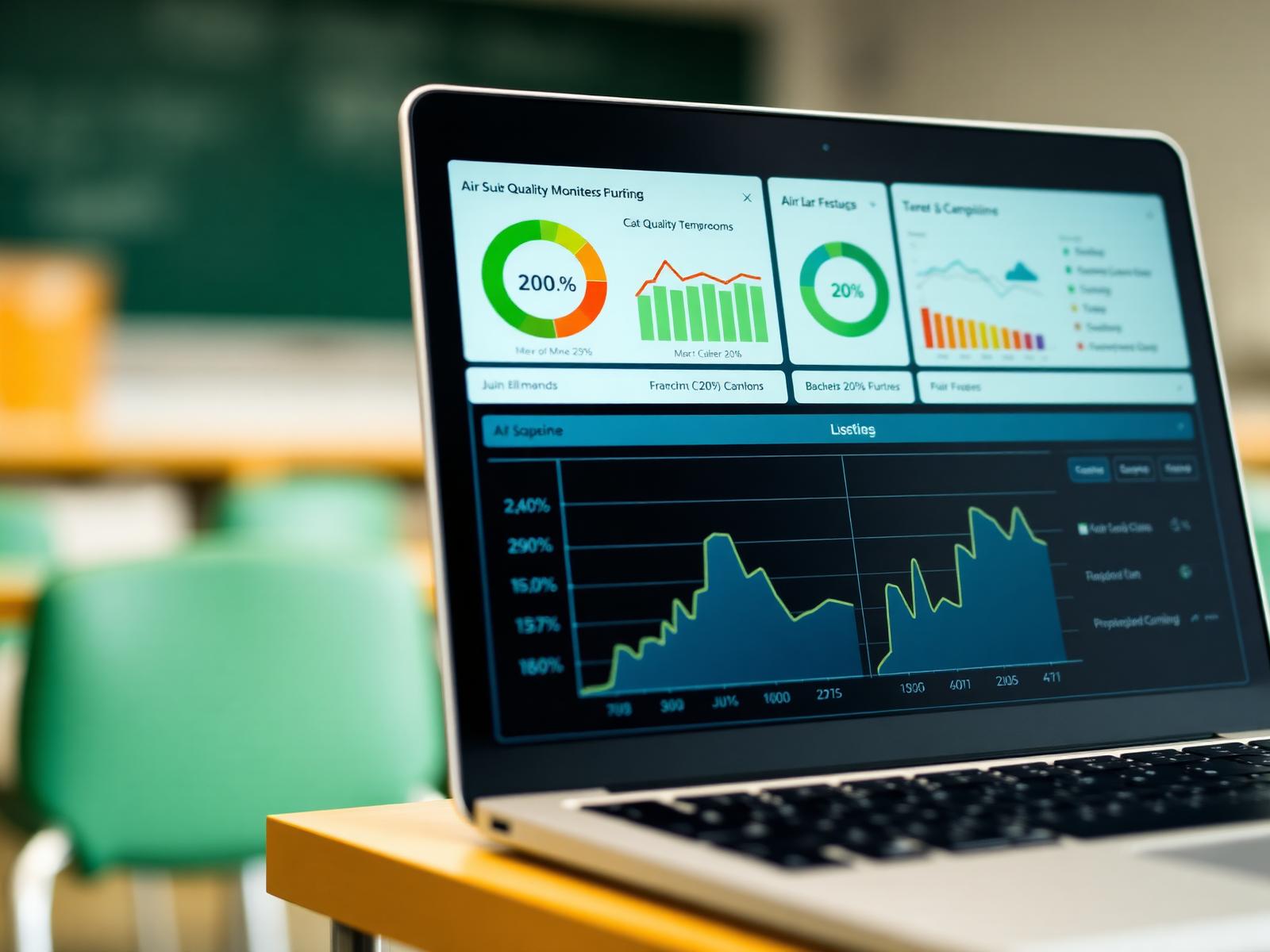
Continuous monitoring is designed for exactly this context. By recording at consistent intervals over weeks or terms, it reveals which rooms behave well consistently, which behave well only on quiet days, and which sit on the edge of acceptable conditions whenever they are fully occupied.
Short-term snapshots versus long-term trends
Short-term sampling and formal testing answer specific questions: is a pollutant present at a particular level, has a refurbishment been ventilated adequately before reoccupation, does an investigation room show signs of a defined source. These are the right tools for those questions.
Long-term trend data answers a different set of questions: which rooms are reliably comfortable, which are recurrently overloaded with CO₂ at certain points of the day, whether a recent change has had a measurable effect, and which areas would benefit from focused intervention. The two approaches are complementary, not interchangeable.
School-day, weekly and seasonal patterns
Continuous data almost always exposes clear school-day rhythms — lesson-cycle CO₂ rises, lunchtime resets, end-of-day declines. It also exposes weekly patterns linked to timetable structure, and seasonal patterns linked to heating and outdoor air quality. These rhythms are visible in the data within a few weeks of deployment and become more reliable as more data accumulates.
Occupancy and ventilation effects
Two rooms with identical equipment can behave very differently if they have different occupancies, different opening windows, or different ventilation systems. Continuous monitoring makes those differences visible — and crucially, makes the effect of operational changes (window-opening routines, mechanical ventilation tuning, room-use changes) measurable rather than assumed.
Alerts and thresholds as operational indicators
Thresholds and alerts are most useful when treated as operational signals: a room exceeding a CO₂ value during occupancy is a prompt to check ventilation in that space, not an emergency. We work with schools to tune thresholds so that alerts identify situations worth acting on and avoid alarm fatigue, which quickly erodes trust in any monitoring system.
Baseline monitoring and post-intervention comparison
One of the most useful applications of continuous monitoring is establishing a baseline before a change — a ventilation upgrade, a refurbishment, a change in occupancy patterns — and then comparing the same metrics after the change. This turns intervention decisions from intuition into evidence and gives estates teams a defensible record of the difference made.
Data review and reporting
Continuous datasets only become useful when someone reviews them. Deployments are paired with periodic reports written for school audiences: which rooms behaved well, which need attention, what the data does and does not tell you, and what to consider next. Reports avoid raw graphs in isolation and focus on actionable interpretation.
Limitations of single-parameter monitoring
Continuous monitoring is most reliable when more than one parameter is used in combination. CO₂ alone is a strong ventilation indicator but tells you little about particulates; PM2.5 alone says little about ventilation adequacy. Sensible deployments combine the parameters that actually matter for the question, rather than chasing the longest possible parameter list.
Suitable schools and settings
- Schools establishing a baseline before a ventilation upgrade
- MATs comparing buildings or sites on the same basis
- Schools investigating recurring comfort or air quality complaints
- Estates teams managing planned refurbishment programmes
Frequently asked questions
How is continuous monitoring different from a one-off test?+
A one-off test captures a snapshot at a single point in time. Continuous monitoring records data across school days, weeks and terms, so patterns — rather than isolated readings — become the basis for interpretation. That distinction matters in schools because occupancy, weather and ventilation behaviour change constantly.
How long should a continuous monitoring deployment run?+
It depends on the question. A minimum of two to four weeks usually establishes a baseline; a full term gives a useful seasonal picture; a year captures heating and non-heating season behaviour. We help schools right-size the deployment to the decision the data needs to support.
Can continuous monitoring prove regulatory compliance on its own?+
Generally no. Sensor-based monitoring is highly valuable for operational management and trend analysis, but standards and statutory testing usually require specific reference methods. We are clear with schools about where continuous data is sufficient and where reference testing or formal assessment is needed alongside it.
What happens if alerts are triggered frequently?+
Alerts should be set as operational indicators, not panic buttons. Threshold tuning during the first weeks of deployment is normal, and persistent alerts almost always point to a real underlying issue — typically a ventilation, occupancy or activity pattern that warrants attention rather than a sensor problem.
How is the data reported back to the school?+
Schools receive periodic written reports summarising the data, highlighting patterns and recommending operational actions. Dashboards are typically available to nominated staff, and reports are written in language that estates teams, business managers and senior leaders can act on directly.
Ready to take a closer look at your school's air?
Tell us about your buildings and the rooms or year groups you're concerned about. A specialist will be in touch within one working day.