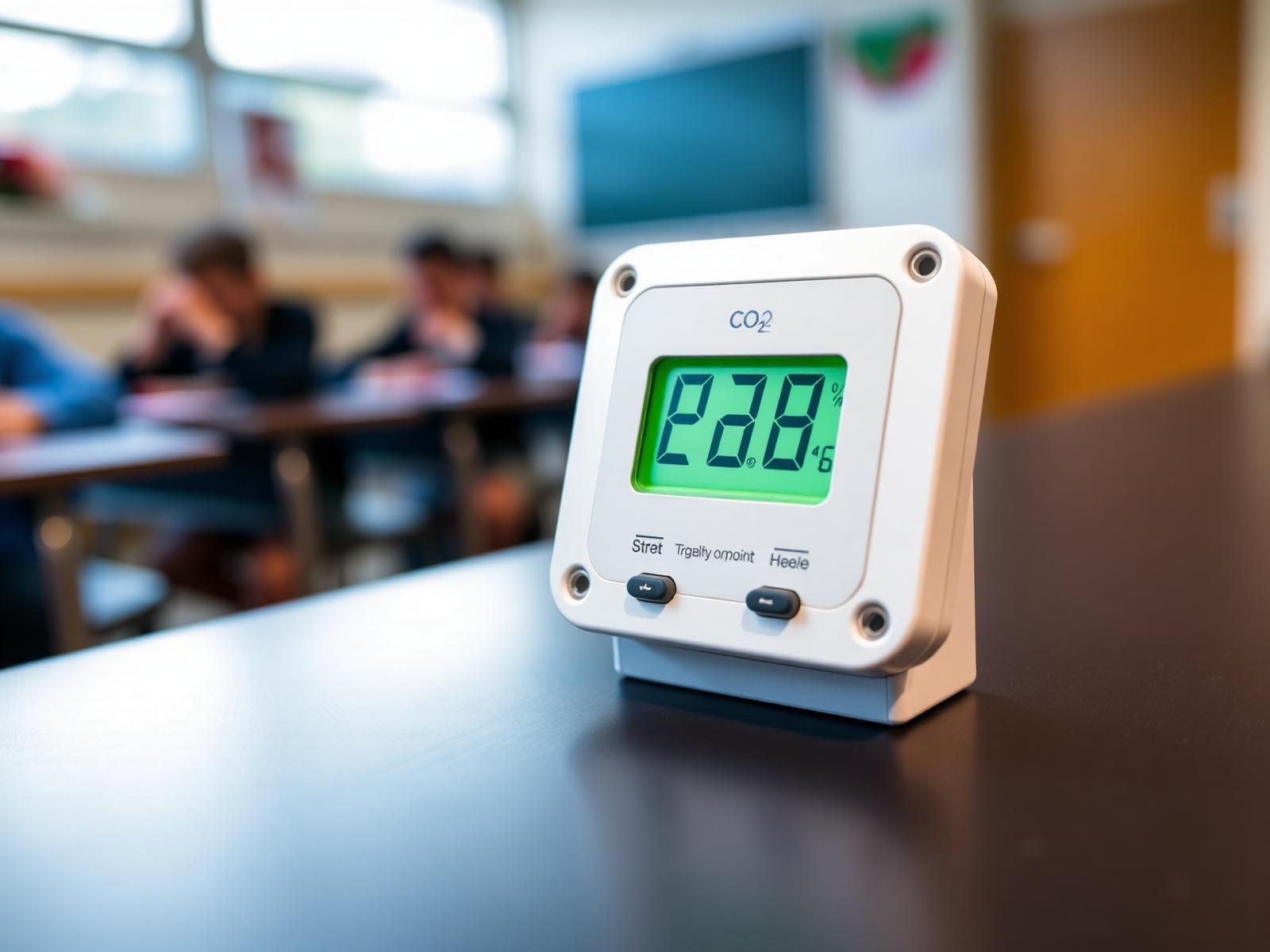
Why CO₂ matters in classrooms
Carbon dioxide is the most useful single number a school can measure to understand how well its rooms are ventilated. It rises predictably with occupancy and falls when fresh air is supplied — making it an honest indicator of whether ventilation is keeping up with how the room is being used.
Sustained high CO₂ in a classroom is almost never about CO₂ itself. It is a marker that the same air is being recirculated through the same lungs, accumulating other pollutants alongside, and that the room feels stuffy, warm and tiring. Pupils and staff feel it in concentration, attention and comfort.
How CO₂ behaves across a teaching day
A typical occupied classroom shows a characteristic CO₂ pattern: a rapid rise during lessons, brief partial recovery at break, a further rise after break, lunchtime recovery, and a final afternoon climb that depends heavily on how windows and ventilation are operated.
Rooms with adequate ventilation level off comfortably below 1,000 ppm. Rooms that struggle climb steadily, with afternoon readings of 1,500–2,500 ppm in poorly ventilated naturally-ventilated classrooms in winter being common. Understanding this pattern — not the peak alone — is what drives sensible recommendations.
Short-term and continuous monitoring options
We offer two complementary approaches. A short-term study deploys CO₂ monitors across a chosen set of rooms for one to four teaching weeks, building a focused dataset to characterise behaviour. Continuous monitoring keeps sensors in place ongoing, integrated into a dashboard so staff and estates teams can see live conditions and trends.
Most schools benefit from a short-term study to identify priority rooms, followed by continuous monitoring in those spaces to support operations and demonstrate the impact of improvements.
What our CO₂ studies capture
- • CO₂ concentration at classroom level
- • Temperature and relative humidity for context
- • Occupancy pattern across the teaching day
- • Window and ventilation operation notes
- • Comparison to BB101, CIBSE TM40, BS EN 16798
- • Optional PM2.5 and VOC for a fuller picture
Interpretation and outputs
- • Plain-English written report
- • Room-by-room CO₂ profiles and benchmarks
- • Quick wins for ventilation operation
- • Capital recommendations where needed
- • Termly trend summaries (continuous monitoring)
- • Evidence to share with governors and parents
Suitable schools and settings
- Primary and secondary classrooms
- Science labs and design / technology rooms
- School halls and large-volume spaces
- SEND classrooms with specific comfort needs
- MAT-wide standardised CO₂ programmes
- Refurbishment before-and-after studies
- Schools responding to parental or staff concerns
- Independent and sixth-form colleges
Frequently asked questions
Why is CO₂ monitored in schools?+
Carbon dioxide is exhaled by occupants and accumulates in poorly ventilated rooms. It is the simplest, most reliable indicator of how well a room's ventilation is keeping up with its occupancy. CO₂ on its own is not a major health hazard at the levels seen in schools, but elevated CO₂ correlates with stuffiness, drowsiness, reduced concentration and a build-up of other indoor pollutants.
What CO₂ level is too high in a classroom?+
Most UK and international guidance treats 1,000 ppm as a target ceiling for occupied rooms, with daily averages comfortably below that. Sustained readings above 1,500 ppm — and especially above 2,000 ppm — indicate ventilation that is clearly struggling against the room's occupancy. BB101 sets specific criteria for new and refurbished schools.
What's the difference between a short-term study and continuous monitoring?+
A short-term study deploys monitors for one to four teaching weeks to characterise a specific room or set of rooms. Continuous monitoring keeps sensors in place ongoing, supporting day-to-day operations, complaint response and refurbishment evaluation. Most schools benefit from a short study first and then move to continuous monitoring for the rooms that matter most.
Do we need monitors in every classroom?+
Not necessarily. A representative subset of high-occupancy rooms across the buildings usually gives a good picture. Where rooms are used very differently (labs, music rooms, halls, SEND classrooms), it is worth covering each type rather than assuming they behave the same way.
What can a school do with CO₂ data?+
Use it to time window-opening and break ventilation, adjust mechanical run-times and schedules, identify rooms that need commissioning or upgrade, evidence refurbishment business cases, and respond credibly to staff or parent concerns.
Ready to take a closer look at your school's air?
Tell us about your buildings and the rooms or year groups you're concerned about. A specialist will be in touch within one working day.