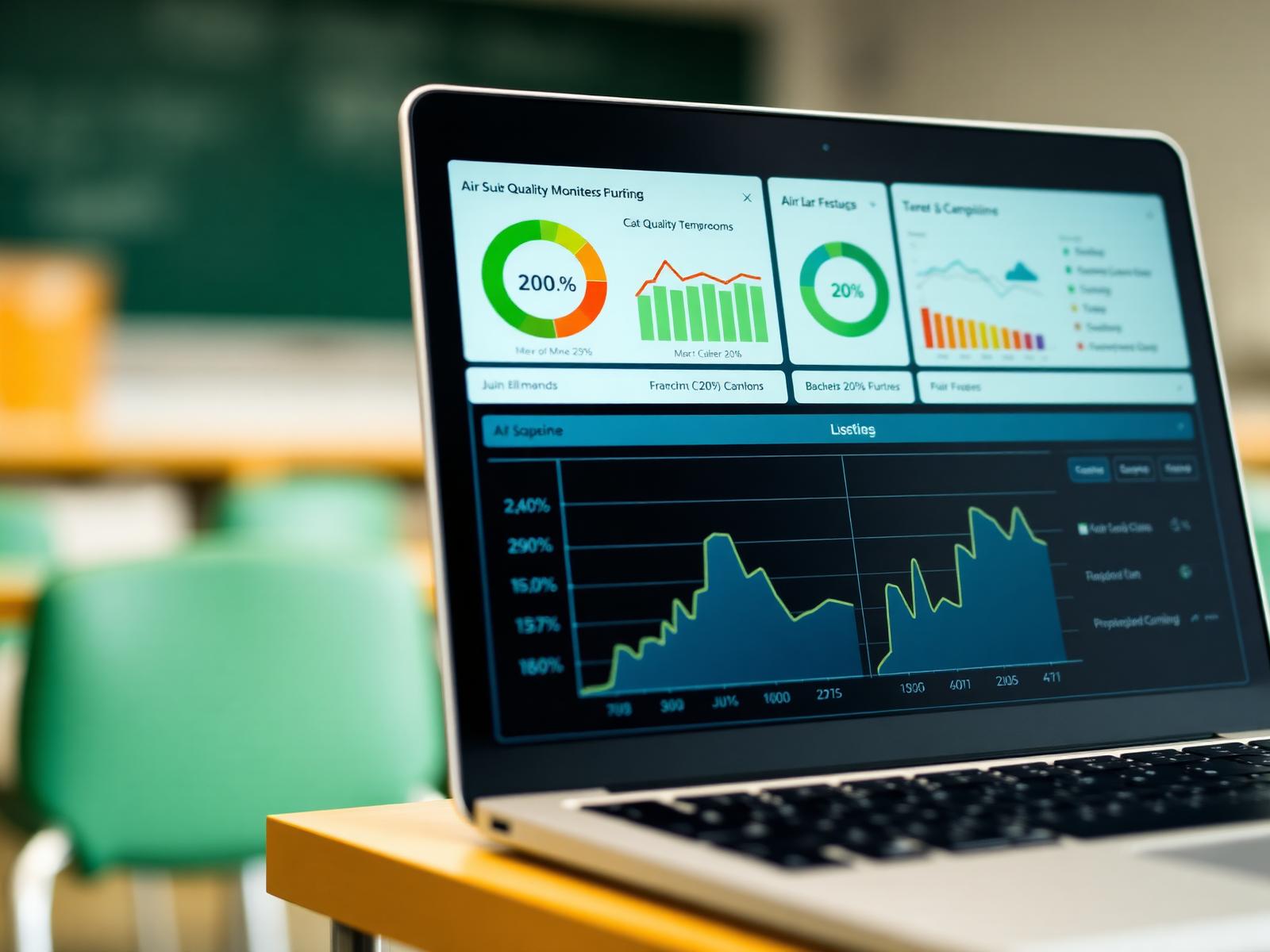
Live visibility in the classroom
Real-time monitoring is not about producing more data — it is about producing data quickly enough for someone in the room to act on it. In a school, that usually means CO₂, temperature, humidity and (where relevant) particles, refreshed often enough to support an in-lesson response.
Used well, live monitoring gives teachers and site staff a feedback loop they previously did not have: a clear, objective signal that ventilation needs adjusting, that the room is warming up faster than expected, or that conditions are perfectly fine.
Parameters that benefit from being live
Not every parameter belongs on a live display. CO₂ rises and falls quickly with occupancy and ventilation and is genuinely useful in real time. Temperature and humidity are similarly responsive and behaviourally useful. Particulate matter and VOC indicators can also be helpful, but tend to be more meaningful when reviewed as patterns rather than minute-to-minute readings.
Selecting a focused, sensible set of live parameters is more useful than presenting everything available. Less, well-chosen data is easier to act on.
Classroom dashboards and in-room displays
Schools generally use one of three patterns: an in-room display visible to the teacher and class; a staff-room or central dashboard reviewed by site staff; or both. Each suits different settings. Primary classrooms often benefit from visible displays that prompt window-opening routines; secondary settings often prefer centralised visibility with notifications to specific staff.
Alert logic that supports action
Alerts should be tied to thresholds that genuinely indicate a need to act, with sensible cool-down logic so that the same condition does not trigger repeatedly. We help schools tune thresholds during the first weeks of deployment, when occupancy and ventilation patterns become clearer.
The aim is consistent: alerts that point to real, actionable situations and that staff trust enough to respond to.
Practical actions for staff
Live monitoring is most effective when paired with simple, agreed responses. For CO₂, that typically means adjusting ventilation — opening windows, increasing mechanical ventilation, repositioning the class within the room. For temperature, adjusting controls, shading or fans. These actions become routine quickly when the data is visible and the response is clear.
Avoiding alarm fatigue
Any monitoring system that alerts too often quickly stops being trusted. We design deployments to keep alerts meaningful: tuned thresholds, sensible time windows (alerts during occupancy rather than overnight), and a tight list of parameters that warrant a live response. The goal is to make alerts useful, not constant.
Interpreting live readings in context
A reading is not a verdict. CO₂ rises naturally in any occupied room and only matters when it stays high or rises faster than the room can recover. Temperature reading slightly above target is not the same as sustained overheating. Reporting and training help staff interpret live data sensibly rather than reacting to every individual reading.
Live data and longer-term review
Most live monitoring systems also retain historic data, which is reviewed periodically alongside continuous monitoring outputs. The live view supports day-to-day decisions in the classroom; the retained data supports termly review, baseline comparison and longer-term planning at estates level.
Suitable schools and settings
- Primary and secondary classrooms with active ventilation routines
- Schools piloting in-room CO₂ displays
- Sites where central facilities staff can act on classroom-level alerts
- Schools using live data alongside continuous monitoring programmes
Frequently asked questions
What does 'real-time' actually mean in a classroom?+
It usually means sensor readings updating every few seconds to a few minutes, visible on a dashboard or in-room display while a lesson is happening. The point is that staff can see conditions changing during occupancy and respond, rather than reviewing data after the fact.
Should we put a screen in every classroom?+
Not necessarily. Some schools use in-room displays as a behavioural prompt; others prefer a central dashboard accessed by site staff. The right answer depends on how the data will be used and who is expected to act on it. We help schools decide before deployment rather than retrofitting the question later.
How do staff act on a live reading sensibly?+
By following pre-agreed actions tied to the parameter — for CO₂, that usually means opening or adjusting ventilation; for temperature, adjusting controls or shading. Live readings are most useful when they sit inside a simple, agreed routine rather than being interpreted ad hoc each time.
How do we avoid alarm fatigue?+
By tuning thresholds carefully, choosing a small number of parameters that actually need a live response, and avoiding repeating alerts for the same condition. Alerts that trigger constantly are quickly ignored — and that erodes the value of the system.
Is live data retained, or only shown live?+
Most systems both display live and retain the underlying data, which is then available for longer-term review. The two functions are complementary: live data supports day-to-day action, retained data supports trend analysis and continuous monitoring reporting.
Ready to take a closer look at your school's air?
Tell us about your buildings and the rooms or year groups you're concerned about. A specialist will be in touch within one working day.