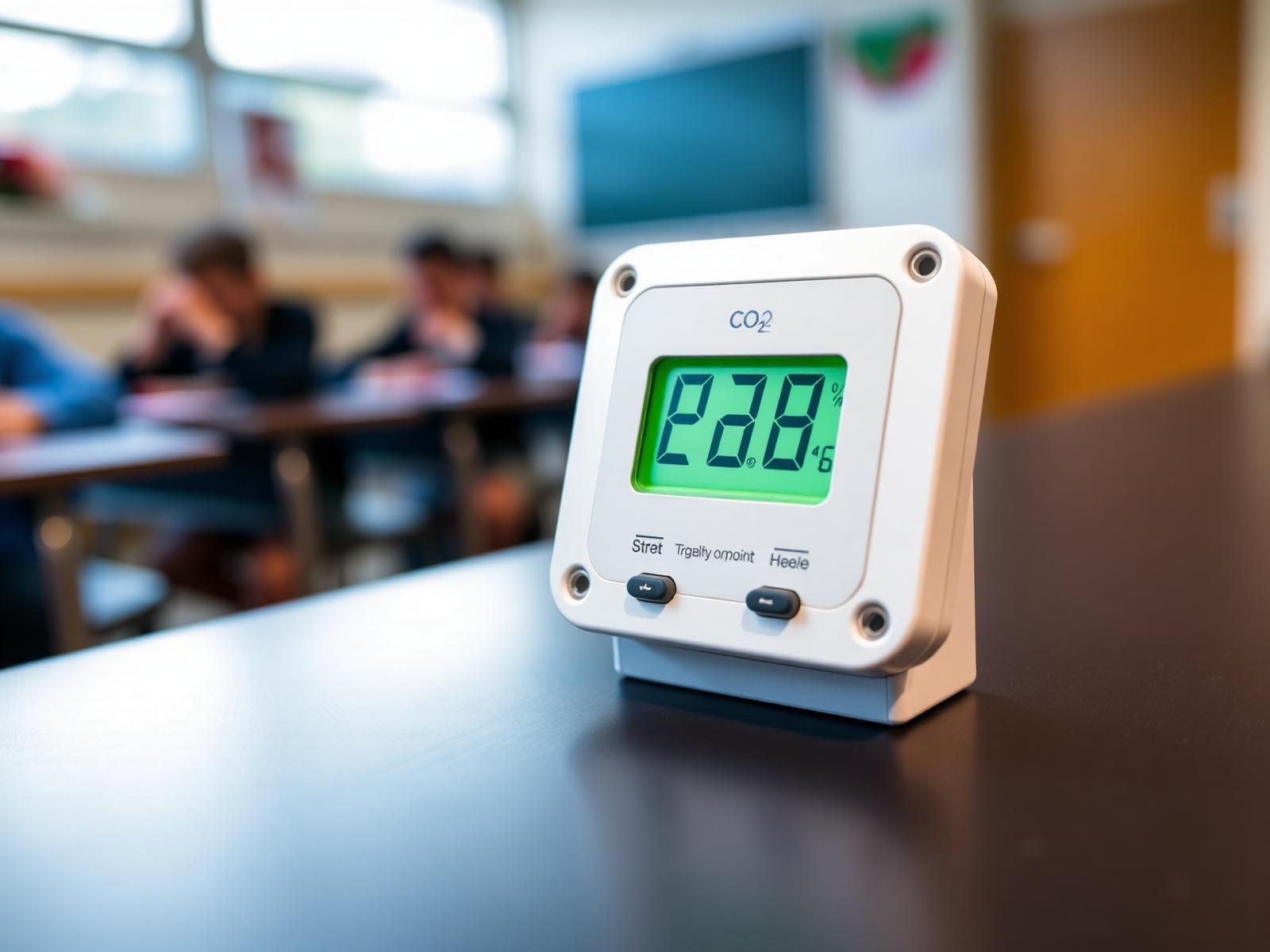
Wireless monitoring in a school context
Most school estates were not designed with continuous monitoring in mind. Cable routes are awkward, classrooms are in use for most of the year, and any installation that demands containment, trunking or repeated room access becomes hard to schedule.
Wireless monitoring sidesteps most of those constraints. Sensors are typically small, can be sited where they are most useful for the brief, and can be relocated or repurposed without a second installation project.
Room-to-room deployment
A typical wireless deployment covers a set of representative classrooms, plus selected shared spaces (halls, libraries, larger laboratories) and, where relevant, one or two outdoor reference points. The aim is to capture meaningful coverage of the way the building is actually used rather than spreading sensors evenly without a question to answer.
Where estates teams want estate-wide visibility, the same approach is replicated across buildings, with a consistent methodology that allows direct comparison.
Connectivity: Wi-Fi, gateway and cellular
Wireless sensors connect to back-end systems in one of three common ways: directly via the school's Wi-Fi, through dedicated low-power gateways that aggregate sensor traffic, or via cellular connections where appropriate. Each has trade-offs — Wi-Fi is straightforward where the school already has good coverage; gateways suit larger or older buildings; cellular suits sites where the IT team prefers full separation from school networks.
We discuss the choice with the school's IT team before deployment rather than assuming one model fits every site.
Battery and mains-powered options
Many wireless sensors are battery-powered with multi-year battery life under typical school conditions, which makes them easy to place and move. Others use mains power, which suits permanent deployments and parameters that draw more current. Selection depends on the room, the parameters and how stable the deployment is expected to be.
Placement flexibility
Wireless sensors can be sited where the air being assessed actually is — in the breathing zone of the room, away from direct draughts, away from heat sources and out of direct sunlight where possible. That flexibility makes a measurable difference to data quality. Wired installations often force compromises on placement; wireless deployments rarely have to.
Installation disruption
Most wireless deployments are completed during a single visit, often without removing classes from the rooms involved. That is a meaningful operational advantage in a working school and one of the practical reasons wireless monitoring has become the default in education settings.
Network and security considerations
Connectivity is set up with sensible defaults: encrypted transmission, no direct access to sensitive school systems, and clear documentation of what is transmitted and where it goes. Schools and MATs with formal IT policies are involved early so the deployment meets internal standards. We do not claim certifications that the underlying platform does not actually hold.
Maintenance and connectivity checks
Wireless deployments are not 'install and forget'. Periodic checks confirm that all sensors are reporting, that battery levels are healthy, and that calibration is within expected drift. These checks are usually built into the same review cycle as data reporting, and most schools find them light-touch in practice.
Suitable schools and settings
- Schools rolling out monitoring without disrupting teaching
- Older buildings where cabling is impractical
- MAT estates standardising on a single monitoring approach
- Sites planning phased deployment across multiple buildings
Frequently asked questions
What is the practical advantage of wireless monitoring?+
It reduces installation disruption and gives much more flexibility on sensor placement. Wired systems usually require cabling routes that are awkward in older school buildings; wireless monitors can be sited where they are needed and moved later if the brief changes.
Will the sensors interfere with the school network?+
Well-designed wireless monitoring uses low-bandwidth data transfer and routes traffic through dedicated gateways or, in some deployments, a separate cellular connection. Discussion with the school's IT team is part of any deployment plan to confirm the right approach for the site.
Do the sensors need mains power?+
Some do, some do not. Many wireless sensors are battery-powered with multi-year battery life under typical school use; others use mains. We help schools choose based on the room, the parameters being measured and how often the sensor will be moved.
Are wireless sensors as reliable as wired ones?+
For the parameters most relevant in schools — CO₂, temperature, humidity, particles — modern wireless sensors are reliable and well-suited to longitudinal monitoring. Reliability depends much more on placement, calibration and maintenance than on whether the link is wired or wireless.
How is security handled?+
Connectivity is configured to follow accepted practices: encrypted transmission, segregation from sensitive school systems where appropriate, and clear documentation of what data leaves the site. We do not claim formal IT security certification unless the specific platform in use carries one and the school's IT team has reviewed it.
Ready to take a closer look at your school's air?
Tell us about your buildings and the rooms or year groups you're concerned about. A specialist will be in touch within one working day.