Higher-education buildings have their own profile
Higher-education estates typically include a wide age range of buildings — Victorian, mid-century, 1990s rebuilds and recent additions — each with different ventilation strategies and fabric. Even within one building, room types and occupancy patterns vary considerably. A meaningful assessment recognises that variation rather than treating the estate as a uniform set of rooms.
Lecture rooms, seminar rooms and teaching spaces
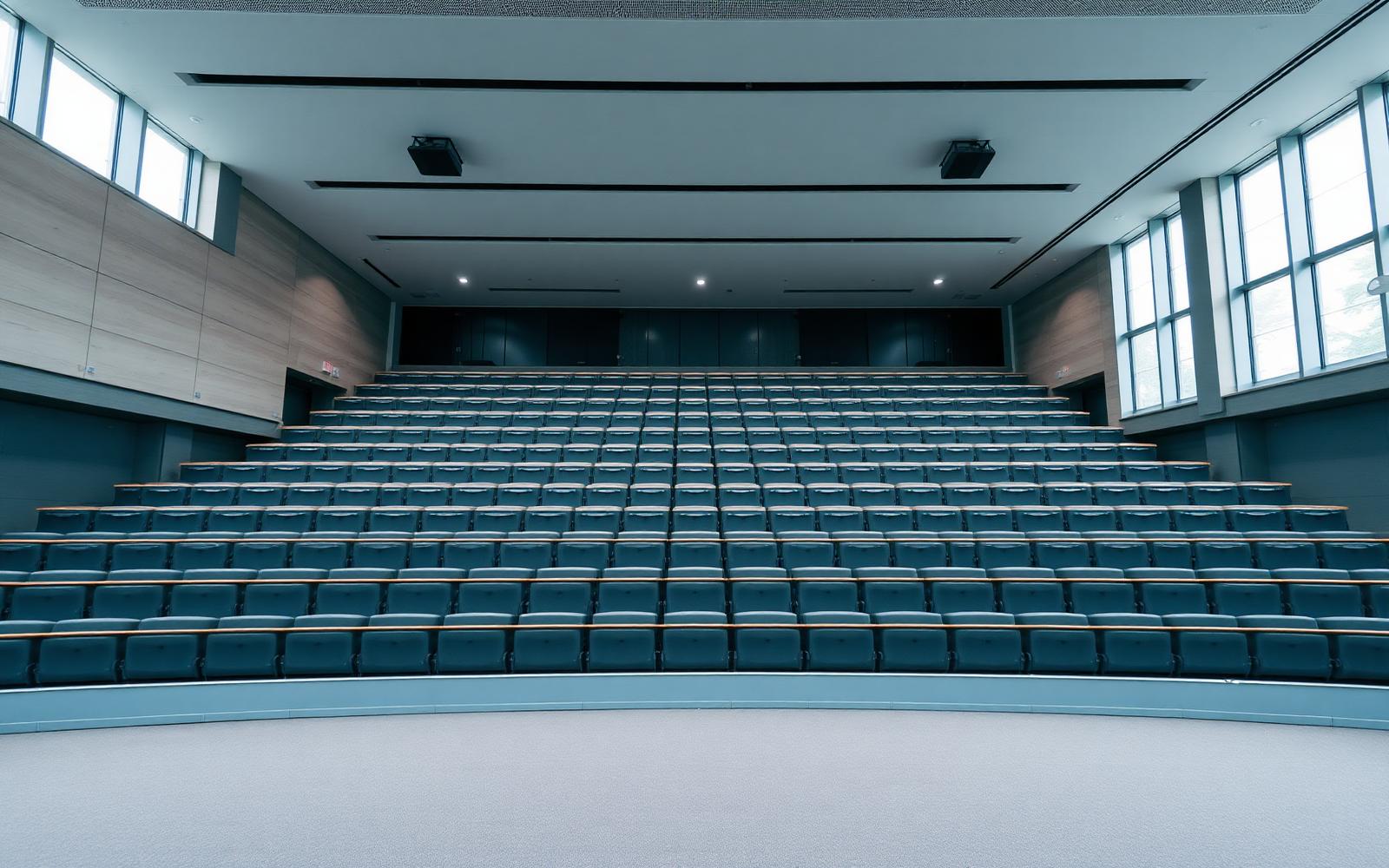
Lecture rooms and theatres can be heavily occupied for an hour and empty the next. Seminar rooms are smaller and more frequently used. Standard teaching rooms sit between the two. Each is assessed with that occupancy pattern in mind — peak-occupancy ventilation is the more useful indicator in a lecture theatre, while in a seminar room consistency across the working day matters more.
- Lecture theatres — peak-occupancy ventilation assessment
- Seminar rooms — sustained-occupancy comfort and CO₂
- Standard teaching rooms — baseline classroom assessment
- Libraries and study areas — long-dwell comfort focus
- Shared and circulation spaces — context for adjacent rooms
Libraries and long-dwell study spaces
Library and silent-study spaces are characterised by long dwell times and relatively quiet occupancy. CO₂ may stay within a reasonable range even at moderate occupancy because the activity level is low, but thermal comfort and humidity become more prominent — students are sitting in one place for hours. Reporting reflects that emphasis.
Teaching laboratories — scoped carefully
General-purpose teaching laboratories can be assessed alongside other teaching rooms where their use is similar in pollutant and ventilation terms. Specialist research laboratories — particularly those handling hazardous substances, with engineered containment or LEV systems — sit under different statutory frameworks such as LEV thorough examination and COSHH. Where those apply, we say so explicitly and do not substitute a general air-quality assessment for the specialist regimes that exist for that reason.
Large estates and varied occupancy patterns
On a large campus, a representative sample of rooms across building age, location and use type produces more useful insight than a uniform survey of every classroom. We agree the sampling approach with the estates team and document it transparently in the report so the basis of findings is clear and repeatable in future cycles.
Ventilation and thermal comfort
Mechanical ventilation in HE buildings ranges from full air-handling units in newer blocks to mixed-mode and natural ventilation in older buildings. The assessment reports observed performance during the visit, sets it in the context of building age and design, and identifies operational and maintenance items as well as longer-term capital opportunities.
Monitoring data and reporting for estates teams
Where ongoing monitoring is appropriate, we describe how a deployment can be staged across representative buildings and rooms, what the data can and cannot tell you, and how it feeds into both day-to-day operations and longer-term estate planning. Monitoring is presented as an input to decisions, not a substitute for them.
Suitable schools and settings
- University estates teams running a structured air-quality programme
- Building-level surveys of a specific lecture or teaching block
- Refurbishment and retrofit projects needing a baseline
- Estates responding to student or staff feedback
- Net-zero and sustainability teams integrating IAQ data
Frequently asked questions
How does university air quality testing differ from a school assessment?+
Higher-education estates are typically larger, more varied and have less predictable occupancy. Lecture rooms can be full one hour and empty the next, libraries are occupied for very long periods, and teaching spaces vary considerably in size and use. The method is the same — structured walk-through and environmental measurements — but the scoping and prioritisation work harder because the estate is more heterogeneous.
Are laboratories included?+
Laboratories vary considerably. General-purpose teaching laboratories can sit reasonably within a standard indoor air-quality assessment alongside other teaching rooms. Specialist research laboratories — particularly those handling hazardous substances or with engineered containment — sit under separate frameworks such as LEV examination and COSHH and need to be scoped explicitly. We do not present general air-quality testing as a substitute for those.
Is whole-estate monitoring an option?+
Yes, where it makes sense. For larger estates, deploying a network of monitors across representative spaces gives a longitudinal picture that a single site visit cannot. We describe the deployment, what the data can and cannot tell you, and how it feeds into estates decisions — rather than presenting monitoring as an end in itself.
Who receives the report?+
University reports are typically written for estates and facilities leadership, with building-level summaries usable by individual building managers and academic stakeholders. Where governance committees are involved, a plain-English executive summary is included.
Do you make compliance guarantees?+
No. Reports describe environmental findings against widely used reference values and good-practice guidance, and recommend practical actions. They do not present testing as a guarantee of compliance with any specific regulation, and they do not make medical claims about individuals.
Ready to take a closer look at your school's air?
Tell us about your buildings and the rooms or year groups you're concerned about. A specialist will be in touch within one working day.